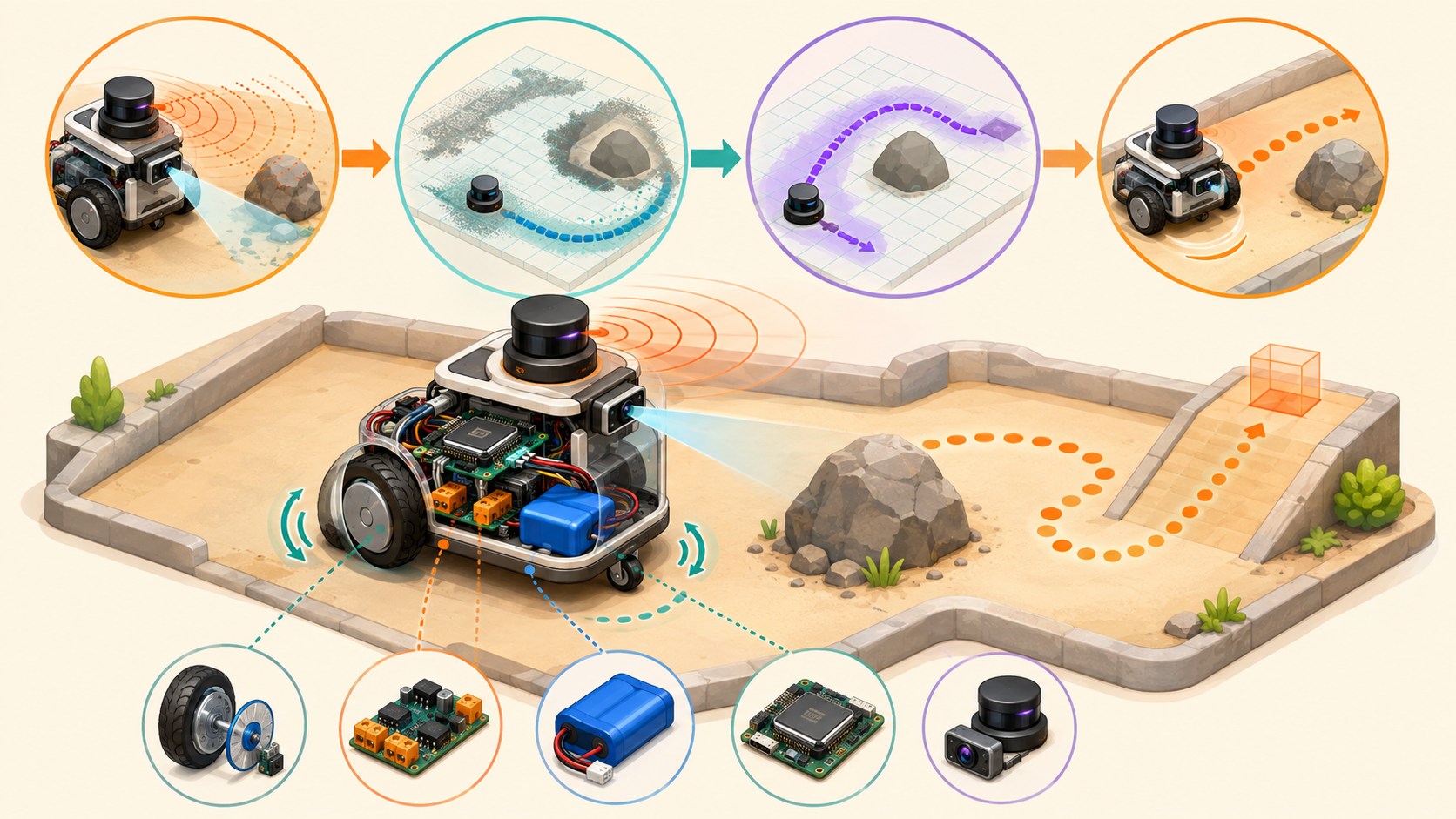
Autonomy becomes easier to debug when the robot is built in observable layers. Each stage should have a clear input, output and test before the next subsystem is introduced.
1. Make power and motion predictable
Start with regulated power, accessible isolation and a drive system that can run safely on a stand. Measure current, direction and response rather than assuming the motor command is correct.
2. Add manual control
Teleoperation gives you a known command source. A joystick interface—like the Academy4Tech Logitech F710 project—also exposes dead zones, axis orientation, message timing and emergency-stop needs.
3. Measure movement
Encoders and an IMU turn motion into data. Calibrate scale and direction, log the measurements and compare them with real displacement.
4. See the environment
Range sensors, LiDAR or cameras should produce inspectable output before they influence control. Record datasets so a perception change can be tested against the same inputs.
5. Integrate autonomy in small behaviors
Begin with bounded behaviors such as maintaining heading, stopping at a distance or following a short planned path. Define a safe fallback when a sensor or software node fails.
6. Test the whole system
System tests should cover startup order, stale data, low battery, communication loss and manual override—not only the successful demo path.